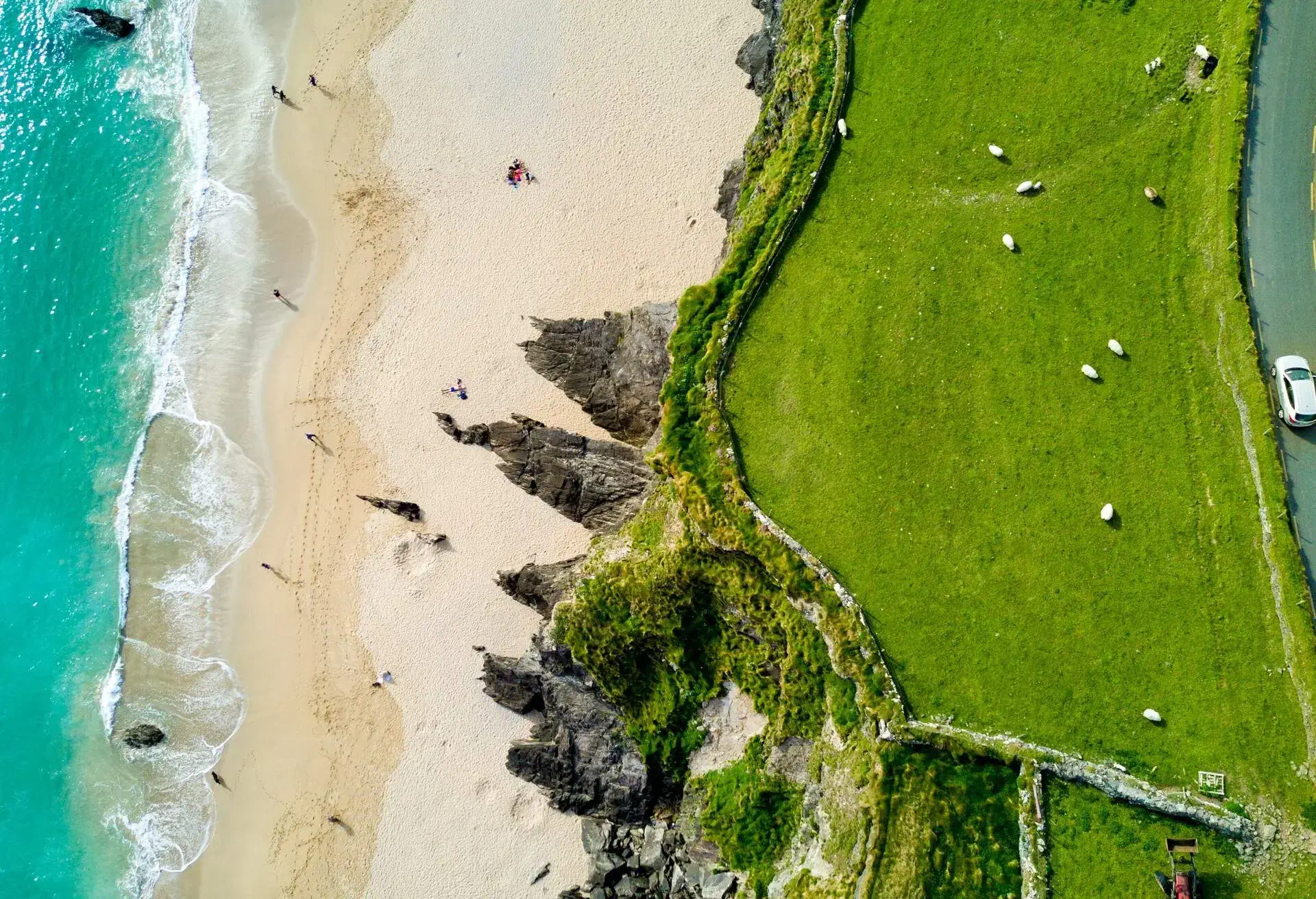

Driving in Ireland means keeping left, just like in the UK. UK licence holders can drive in Ireland for short visits without any additional permits.
Whether you’re bringing your own car via ferry or hiring a vehicle once you arrive, this guide covers everything you need to know about driving in Ireland.
In this article.
- Key driving rules in Ireland.
- Driving in Ireland from the UK.
- Republic of Ireland vs Northern Ireland.
- Requirements for driving in Ireland.
- Taking your own car to Ireland.
- Tips for rural driving conditions.
- Hiring a car in Ireland.
- More rules of the road in Ireland.
- FAQ.
Key driving rules in Ireland.
Before you set off, here are the essential rules you need to know:
- Drive on the left – Ireland drives on the left-hand side, the same as the UK.
- Roundabout priority – give way to traffic already on the roundabout, approaching from your right.
- Speed limits – speed vans are common so keep an eye on the limits. Built-up areas: 30-50km/h. Rural roads: 60-80km/h. Motorways: 120km/h.
- Seat belts – mandatory for all passengers in all seats.
- Handheld phones – put your phone away, using a mobile phone while driving is illegal.
- Drink-driving limits – 0.05% for experienced drivers, 0.02% for learners and professional drivers (lower than England, Wales, and Northern Ireland).
- Child seats – required for children under 3; children under 150cm or 36kg need appropriate restraints.
Driving in Ireland from the UK.
If you hold a valid UK driving licence, you can drive in Ireland for short visits without needing an International Driving Permit. This applies to both the Republic and Northern Ireland.
- UK visitors: Your UK licence is valid for tourist stays. If you plan to stay longer than 12 months or become a resident, you’ll need to exchange your licence for an Irish one.
- First-time drivers in Ireland: If you’re new to driving in Ireland, prepare for kilometres instead of miles on speed limit signs in the Republic, narrow rural roads, and the Irish language on signage. A sat nav is highly recommended, especially in remote areas.
Republic of Ireland vs Northern Ireland: the different driving rules.
If you’re driving across the island, you’ll cross between two jurisdictions with some key differences:
| Factor | Republic of Ireland | Northern Ireland |
|---|---|---|
| Speed units | Kilometres per hour (km/h) | Miles per hour (mph) |
| Road numbering | M, N, R, L roads (e.g., M50, N11) | M, A, B roads (e.g., M1, A1) |
| Signage language | English and Irish | English only |
- Licences: UK licences are valid in both jurisdictions for short visits.
- Insurance: UK car insurance typically covers both the Republic and Northern Ireland, but check your policy.
- Currency: The Republic uses euros; Northern Ireland uses pounds sterling (be mindful of this for things like parking.)
- Drink-driving limits: The Republic has stricter limits (0.05%) than Northern Ireland (0.08%).
The border between the two is open with no checkpoints, so you may cross without realising – watch for the change in speed limit signs from mph to km/h.
Requirements for driving in Ireland.
Before you head off on your holiday or business trip in Ireland by car, make sure you have examined all the rules and requirements related to driving in Ireland. Good news – driving in southern Ireland after Brexit is unchanged for tourists.
What side of the road do they drive on in Ireland?
In Ireland, you drive on the left-hand side of the road, which is the same side as in the UK. That means you can easily drive to Ireland from the UK and stay in your comfort zone.
Motorways and toll roads.
There are eleven toll roads in Ireland, including the M1 that links Gormanston and Monasterboice, the N25 which is the Waterford City Bypass, and the M50 which is a barrier-free toll road (pay the toll fee by 8pm the next day in order to avoid a fine.). In addition to these routes, you will also have to pay to drive through the East Link Bridge, the Dublin Tunnel and the Limerick Tunnel.
All the toll plazas accept card payments and some also accept cash.
Road signage and etiquette.
You may notice there is a different language written with English on road signs – this is Irish Gaelic. Although most Irish people use English as their first language, many still use the traditional tongue. In more remote parts of Ireland like the Gaeltacht areas, only Irish Gaelic is written on road signs, so be sure to plan ahead and use a sat nav where possible to avoid getting lost.
In rural parts of Ireland, roads are often narrow and windy. Don’t feel you need to keep to the speed limit on such roads – you don’t know if a car might be around the next corner. There are plenty of pull ins to allow cars coming in the other direction to pass, so take your time. Driving in Dublin and similar built up places is much the same as in the UK.
Driving on narrow, remote and windy roads can feel overwhelming. The key is to stay calm and take your time. Use a sat nav to plan an alternative route on bigger roads if this is a concern.
Kirstie Pickering, travel expert
Documents and car equipment.
If you want to drive to Ireland from the UK with your own car, you will need to have the following documents with you:
- Valid UK driving licence
- V5 car registration
- Car insurance certificate
In addition to these documents, you are recommended to carry the following items with you in your car:
- Spare bulbs for external lights
- First aid kit
- Warning triangle
- Fire extinguisher
Taking your own car to Ireland: Insurance and documents.
Many people driving in Ireland from the UK take their own car via ferry. All you need to have isa valid UK driving licence, motor insurance certificate and their car’s V5C registration documents. UK car insurance nearly always covers driving in both the Republic of Ireland and Northern Ireland, but double check your policy to be safe.
The rules are different if you’re taking a rental car hired in the UK onto a ferry to Ireland. If you hope to do this, check with your car rental company before making your booking. You must let the car rental company know before you pick up your hire car so they can arrange a VE 103 certificate, which shows you’re allowed to use a hired vehicle if you’re driving it abroad.
Cars are positioned close together on ferries, increasing the risk of damage. Consider whether you could hire a car in Ireland instead of take your UK car abroad if you are a nervous driver.
Kirstie Pickering, travel expert
Practical tips for driving on rural roads.
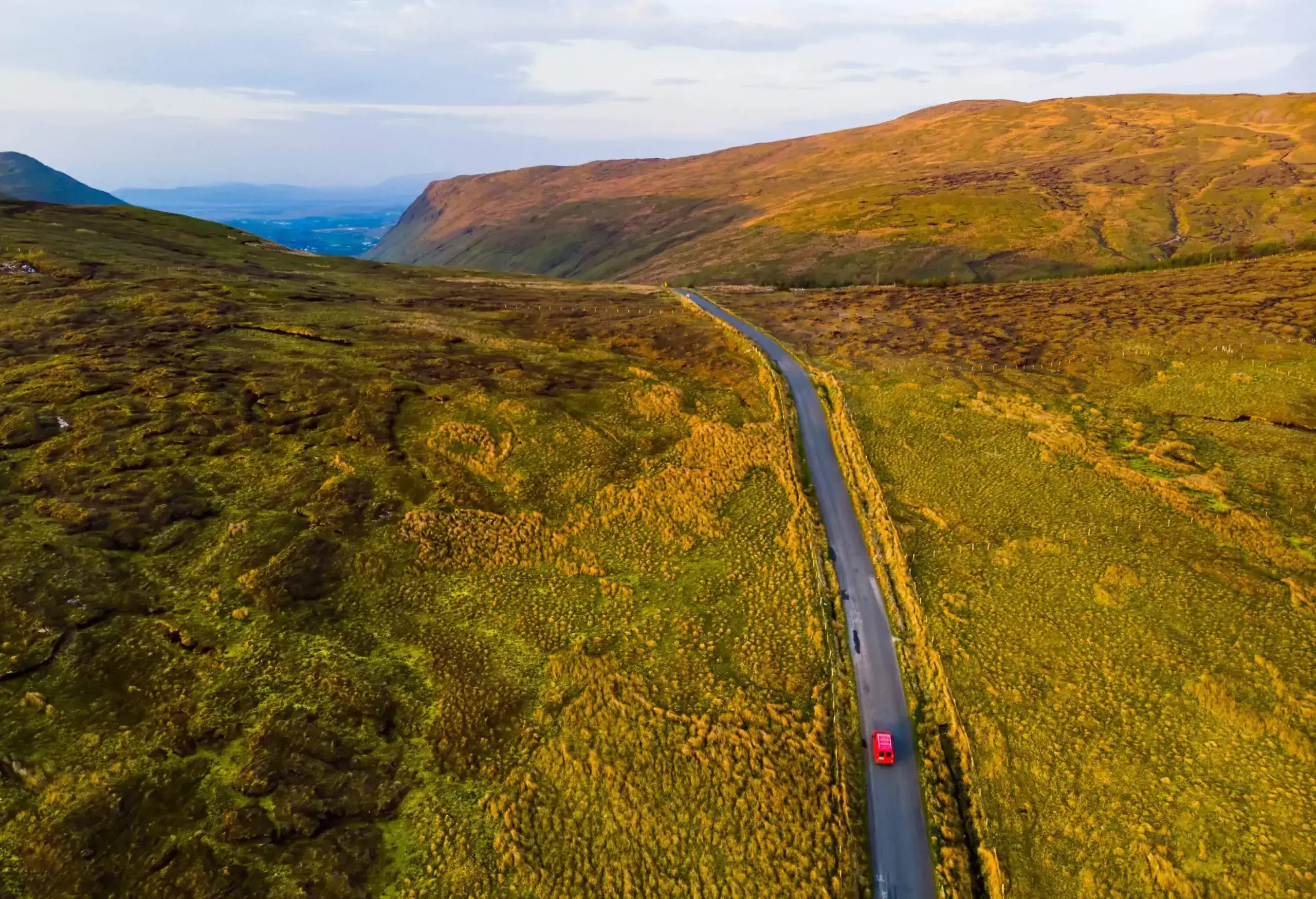
If you are driving across the country, especially to popular tourist spots like Cork and Kerry, you’ll likely come across some rural roads.
- Narrow lanes: Many rural roads have no centre line and are bordered by hedgerows or stone walls. Drive slowly and be prepared to reverse to a passing place.
- Passing places: Look for wider sections or gateways where you can pull in to let oncoming traffic pass. The driver closest to a passing place should use it.
- Blind bends: Rural roads often have sharp, unmarked bends. Reduce speed and stay left – oncoming traffic may be in the middle of the road.
- Farm vehicles: Expect tractors, livestock trailers, and occasionally animals on the road, especially in agricultural areas. Be patient and wait for a safe place to pass.
Hiring a car in Ireland.
Here’s what you need to know if you prefer to leave your car at home and hire a vehicle in Ireland.
What do you need to hire a car in Ireland?
In order to hire a car in Ireland, you must be at least 21 years of age, though many agencies have set their minimum age higher. You will need a full and valid UK driving licence, and some car hire companies require you to have held it for a minimum period.
You will also need to present another proof of identification such as a valid passport, and you will usually need a credit card to pay for the deposit, though some agencies may accept debit cards. Third-party liability insurance is required with any car hire and is usually included in the price.
Is driving to Ireland from UK with a car hire allowed?
While not all car hire companies allow it, there are agencies that will let you take your hire car cross border from the UK into Ireland. Please be aware that you will have to pay an additional fee, which varies by rental company and hire period.
Search for hire cars.
More rules of the road in Ireland.
We’ve already mentioned a few of the key rules of the road in Ireland, but here’s a few more important factors to keep in mind you’re planning on driving to Ireland or doing a road trip within the country.
Minimum driving age
The minimum age for driving a car in Ireland is 17, but drivers can ride a moped or a 125cc motorcycle from the age of 16.
Speed limits
The speed limit in built-up areas in Ireland is generally between 30km/h (about 20mph) and 50km/h (about 30mph). The speed limit goes up outside built-up areas and varies between 60km/h (40mph) and 80km/h (50mph) with clear indications on each road. Finally, the speed limit on motorways is 120km/h (around 75mph).
Roundabouts
When you get to a roundabout in Ireland, you should always give priority to any vehicles that are already on the roundabout. If it is a larger roundabout with multiple lanes, the lane you should enter from depends on where you will be exiting. As a general rule, the left lane is for drivers who will be taking the first exit and the middle lane for those taking the second exit, while the right lane is for those taking the third exit.
Alcohol allowance and drink driving
The maximum alcohol allowance for drivers of private cars in Ireland is 0.05%. This limit goes down to 0.02% for both beginner and professional drivers. Both of these limits are lower than the limit in England, Wales, and Northern Ireland, and the same as Scotland.
Child seats regulations
Children aged up to three years must be placed in an appropriate child seat in the car. Kids aged over three can sit in the front seat as long as they have an appropriate child restraint or safety belt. Any children who measure under 4ft 11in (150cm) and weigh less than 79lbs (around 36kg) must use the correct child seat or booster cushion whenever in the car.
Penalties and fines
Depending on the offence, fines in Ireland vary. For more serious offences, you might get a higher fine and be summoned for a court appearance. Officers (or Garda) can issue on-the-spot fines which you have 28 days to pay, otherwise the value increases by 50%.
Means of payment
The national currency of Ireland is the euro. You can also use credit and debit cards in most public places.
Parking
When looking for a parking space in Ireland, always make sure you look at the signs that indicate the parking rules of each zone. In addition, please note that you are not allowed to park at a bus stop or on yellow lines. Disabled parking is available and indicated by blue lines with the wheelchair symbol. Disabled car parking is normally free and has no time limit.
Fuel
All the major fuel types are available throughout Ireland. You will find petrol under ‘Unleaded’ and diesel under ‘Diesel’. If you are driving an electric car, keep in mind that you will find electric charging points across the country, including in the main cities such as Dublin and Cork. You can typically pay for fuel with cash in euros or by card.




FAQs about driving in Ireland.
Mostly yes, but with some important differences. Both countries drive on the left, use the same roundabout rules, and UK licences are valid in Ireland. However, the Republic of Ireland uses kilometres per hour for speed limits (not miles), road signs include Irish Gaelic text, drink-driving limits are stricter (0.05% vs 0.08%), and the currency is euros. Northern Ireland follows UK rules and uses miles per hour.
To drive your car in Ireland, you will need a valid UK driving licence, a V5 car registration, and a car insurance certificate.
To hire a car in Ireland, you need a full and valid UK driving licence, a valid passport and a credit card to pay for the car hire deposit, though some agencies may accept a debit card instead.
Yes, if you are driving in Ireland with your own car, your UK car insurance should cover your trip. According to gov.uk, ‘All UK vehicle insurance provides the minimum third-party cover to drive in the EU (including Ireland).’
It is recommended to check with your insurer if you can benefit from some extra coverage while you drive your car abroad.
You must be at least 21 years of age to hire a car in Ireland, though many agencies will only hire a car to older drivers.
British passport holders living in or wishing to travel to the EU and EU nationals living in or wishing to travel to the UK from the 1st January 2021 are to be advised that all travel-related information have to be checked on this official webpage in order to inform yourself about all and any information pertinent to Brexit when making travel decisions.